

In today’s fast-growing software landscape, delivering features quickly is often critical to staying competitive. However, rapid development frequently comes at a cost: technical debt. Much like financial debt, technical debt represents shortcuts taken today that may create future costs if left unmanaged.
Understanding, identifying, and managing technical debt is essential for developers, project managers, and business leaders alike, as it directly affects product quality, development velocity, scalability, and overall business outcomes.
What Is Technical Debt?
Technical debt refers to the additional work required to maintain, improve, or correct software due to earlier development decisions. These shortcuts can include rushed coding, incomplete documentation, insufficient testing, or temporary workarounds.
While sometimes strategic-allowing rapid delivery or experimentation-technical debt becomes dangerous when ignored. Unmanaged debt arises “interest,” slowing development, increasing maintenance costs, and raising the risk of bugs or system failures.
It’s important to recognize that technical debt isn’t only about messy code. It is also about the architecture debt, process debt, testing debt, documentation debt, and infrastructure debt. Recognizing the different types is key to managing it effectively.
Types of Technical Debt
Code Debt
Code debt arises when code is written quickly without sufficient attention to clarity, structure, or maintainability. Functions may be overly complex, naming conventions inconsistent, or logic difficult to follow. While such shortcuts allow teams to ship features faster, they increase the effort needed for future changes and heighten the risk of bugs. For example, a function created to deliver an MVP feature may work immediately, but extending or refactoring it later can be time-consuming and error-prone.
Design and Architecture Debt
Architecture debt occurs when system design decisions prioritize short-term delivery over long-term scalability and maintainability. Components may be tightly coupled, modularization insufficient, or high-level design underdeveloped. This type of debt can make scaling or integrating new features challenging. A common scenario is adopting a monolithic architecture for speed, which later becomes a bottleneck as the product grows.
Testing Debt
Testing debt accumulates when automated tests are incomplete, skipped, or postponed. The absence of proper testing increases the likelihood of bugs surfacing late, reducing confidence in new releases. For instance, skipping unit or integration tests to meet a deadline may allow features to ship quickly, but it introduces hidden risks that can disrupt future development cycles.
Documentation Debt
Documentation debt emerges when system diagrams, API specifications, or internal guides are outdated or missing. Without clear documentation, teams struggle to onboard new developers, maintain consistency, and avoid miscommunication. For example, outdated architecture diagrams can force engineers to reverse-engineer solutions, slowing down progress and increasing errors.
Process Debt
Process debt occurs when development workflows are inefficient or inconsistent, such as skipping code reviews, lacking standardized procedures, or ignoring CI/CD practices. These shortcuts can reduce productivity and create unnecessary friction. For example, deploying code without a formal review or testing workflow may expedite delivery initially but leads to long-term quality issues.
Infrastructure Debt
Infrastructure debt arises when teams implement temporary or suboptimal infrastructure solutions. This includes outdated dependencies, lack of monitoring, or insufficiently scalable systems. While such decisions may meet immediate needs, they increase the risk of system instability and hinder growth. For example, deploying on a single server instead of leveraging cloud scalability can impede performance as user demand rises.
Why Technical Debt Happens
Technical debt arises from a combination of strategic decisions and unintentional oversights:
- Time pressure: Tight deadlines often force teams to prioritize speed over best practices.
- Evolving requirements: Changing business or product specifications frequently leave temporary solutions in place.
- Resource constraints: Small teams or limited budgets can compromise thorough development processes.
- Neglected standards: Skipped documentation, inconsistent coding practices, or minimal testing contribute to debt accumulation.
Understanding these drivers helps teams proactively plan to manage or prevent technical debt.
Consequences of Ignoring Technical Debt
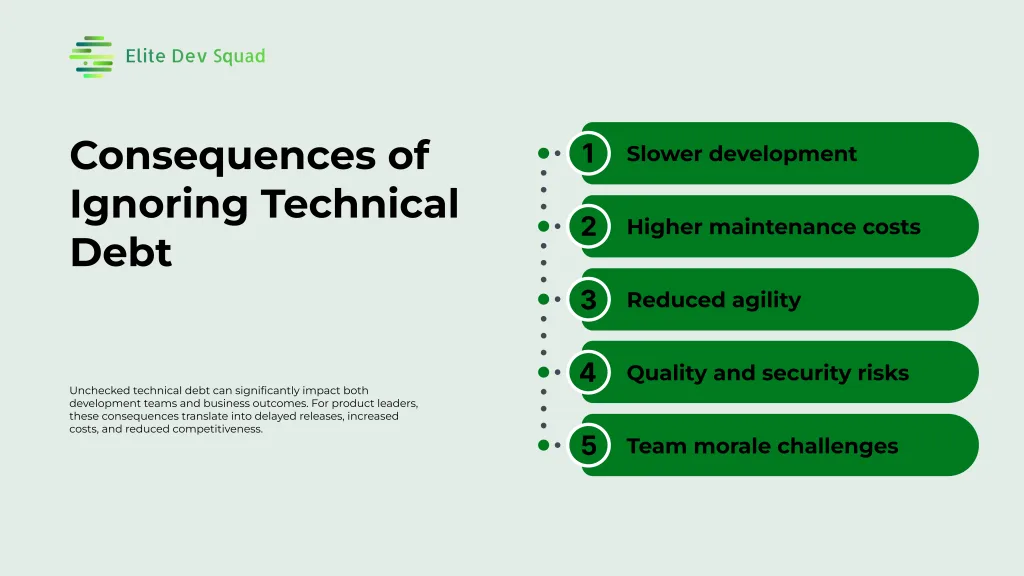
Unchecked technical debt can significantly impact both development teams and business outcomes:
- Slower development: Implementing new features becomes more time-consuming as debt accumulates.
- Higher maintenance costs: More resources are spent fixing bugs, refactoring code, and troubleshooting.
- Reduced agility: Teams struggle to respond to market demands or changing customer requirements.
- Quality and security risks: Temporary fixes may introduce vulnerabilities or instability.
- Team morale challenges: Developers face frustration navigating complex or inconsistent codebases.
For product leaders, these consequences translate into delayed releases, increased costs, and reduced competitiveness.
Managing Technical Debt Professionally
Effectively managing technical debt requires a strategic and proactive approach. Teams should maintain a clear backlog of debt items, continuously assessing their potential impact, and integrate debt management into planning by dedicating regular time during sprints or release cycles for refactoring, testing, and updating documentation. Automation plays a key role: leveraging continuous integration and automated testing helps identify and mitigate issues early, while keeping architectural decisions-such as system diagrams, API contracts, and process documentation to date ensures clarity and maintainability. Adopting consistent coding standards, conducting peer code reviews, and using quality audits prevent the accumulation of new debt. It is equally important to balance speed with sustainability, ensuring that any strategic shortcuts include a repayment plan to maintain long-term code health. By monitoring code quality continuously through metrics and analysis, teams can track complexity, detect potential issues, and maintain overall system integrity. Treating technical debt as a first-class consideration enables teams to preserve development velocity without compromising future stability.
Conclusion
Technical debt is an inevitable aspect of software development, but it can be managed effectively with awareness, planning, and disciplined practices. Teams that understand the types, causes, and consequences of debt are better positioned to deliver high-quality soft.